The post How Pumpkin Pie Became a Thanksgiving Classic appeared first on bake blog.
]]>And custards and pies,
Our pumpkins and parsnips
are common supplies
We have pumpkins at morning
And pumpkins at noon
If it were not for pumpkins
We should be undoon…
From an American Pilgrim Verse, ca. 1630
…But see, in our open clearings, how golden the melons lie;
Enrich them with sweets and spices, and give us the pumpkin-pie!
From “The First Thanksgiving Day, A.D. 1622,”
a ballad by Margaret J. Preston, 1887
Few foods that make up our traditional holiday fare can claim deeper American roots than the pumpkin (cucurbita pepo). Thought to have been first cultivated in Central America around 5,500 BCE, pumpkins had spread north up the eastern seaboard into Canada by the time Europeans began exploring the North American continent in the 15th century. With its thick shell and solid flesh, pumpkins were a sustaining dietary staple for Native Americans as they could be stored through the winter and preserved by slicing and drying them. They also were baked, boiled, stewed, and roasted over a fire for everyday consumption.

Versatile and easy to cultivate, New World pumpkins were among the first botanical specimens European explorers brought back to Europe. They are mentioned in European works beginning in 1536 and within a few decades were grown regularly in England and France, where they were called “pumpions” and “pompions,” respectively, in reference to their rounded form. By the 17th century, pumpkins, whether baked, fried, mashed, roasted, or stewed, featured prominently in English and French cuisine, with myriad recipes, both sweet and savory, appearing in the most influential English and French cookery books of the day. A favorite preparation was to scoop out their seeds, fill the cavity with sweetened, spiced milk, and cook them near a fire. Pumpkins were also used to make puddings, pancakes, pies, soups, stews, and tarts.

When the Pilgrims set sail for America on the Mayflower in 1620, landing on the shores of Cape Cod, they were most likely already familiar with the pumpkins cultivated by the Wampanoag, the Native Americans who helped them survive their first year at Plymouth Colony. From the Wampanoag, the Pilgrims learned how to grow life-sustaining crops, including pumpkins and corn, and how to weather the brutal climate of coastal Massachusetts. A year later, despite losing nearly half of their group to disease and scarcity brought on by a harsh winter, the Pilgrims, together with the Wampanoag, gave thanks for a bountiful autumn harvest with a three-day celebration feast. On the table would have been local root vegetables, like carrots and onions, dried fruits and nuts, waterfowl, wild turkey, venison, lobster, clams, berries, fruit, and pumpkin and squash. Lacking butter, lard, wheat flour, and a dry oven for pastry crust, the closest the Pilgrims would have come to preparing pumpkin pie at the first Thanksgiving and during the early years of the colony, would have entailed, according to some accounts, hollowing out pumpkins, filling the shells with milk, honey, and spices to make a custard, then roasting the gourds whole in hot ashes.

Meanwhile, back in 17th-century England and France, pumpkin pie continued to evolve, taking a number of forms. François Pierre La Varenne (1615–1678), in his Le Cuisinier François, 1651, the revolutionary cookbook that laid the foundation of classic French cuisine and was translated into English as The French Cook in 1653, instructed cooks when making their “pompion” pie to prepare a simple pudding and bake it in a pastry crust:
…boile it with good milk, pass it through a straining pan very thick, and mix it with sugar, butter, a little salt and if you will, a few stamped almonds; let all be very thin. Put it in your sheet of paste; bake it. After it is baked, besprinkle it with sugar and serve.

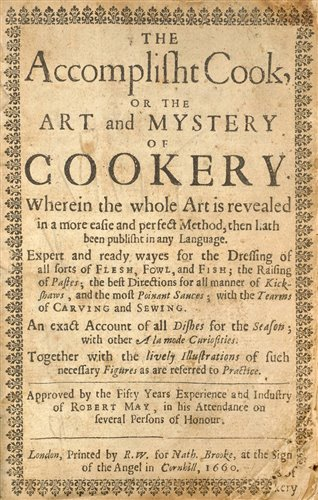
In the influential English compilation, The Accomplisht Cook, 1653, by Robert May (1588-ca. 1664), the recipe for pumpkin pie takes on a completely different character and complexity:
Take a pound of pumpion and slice it, a handful of thyme, a little rosemary, and sweet marjoram stripped off the stalks, chop them small, then take cinnamon, nutmeg, pepper, and a few cloves all beaten, also ten eggs, and beat them, then mix and beat them all together, with as much sugar as you think fit, then fry them like a froise, after it is fried, let it stand till it is cold, then fill your pie after this manner. Take sliced apples sliced thin round ways, and lay a layer of the froise, and a layer of apples, with currants betwixt the layers. While your pie is fitted, put in a good deal of sweet butter before you close it. When the pie is baked, take six yolks of eggs, some white-wine or verjuyce, and make a caudle of this, but not too thick, cut up the lid, put it in, and stir them well together whilst the eggs and pumpion be not perceived, and so serve it up.
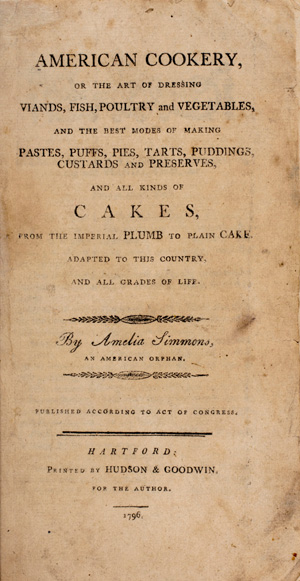
These varying recipes for pumpkin pie, along with the English and French cookbooks that contained them, made their way to colonial America as English settlers continued to colonize New England throughout the 17th and 18th centuries. By the time Amelia Simmons of Connecticut (dates unknown), published her American Cookery in 1796—the first cookbook published in America and the first to meld together Northern European cooking and baking methods with American-sourced ingredients—colonial American cuisine had come a long way since the Pilgrim’s first thanksgiving. Pumpkins were now a dietary staple and a potent symbol of American plenty with American cooks employing them not only in puddings and stews, but also in beer, breads, johnnycakes, porridges, butter, syrups, and last but not least, the bone fide pie in a pastry crust.
Amelia Simmons did not invent the pumpkin pie we now know and love today, but her cookbook contained the earliest American recipe for what has become a Thanksgiving Day classic. Her two recipes for “Pompkin” pie called for similar ingredients to what we use today:
Pompkin
No. 1. One quart stewed and strained, 3 pints cream, 9 beaten eggs, sugar, mace, nutmeg and ginger, laid into paste No. 7 [all butter] or 3 [butter and lard], and with a dough spur, cross and chequer it, and baked in dishes three quarters of an hour.
No. 2. One quart of milk, 1 pint pompkin, 4 eggs, molasses, allspice and ginger in a crust
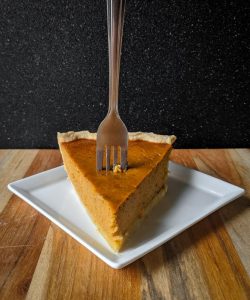
So when did pumpkin pie become the quintessential dessert of the Thanksgiving Day holiday? By the early 18th century, giving thanks for a bountiful autumn harvest with an annual celebratory feast, as the Pilgrims did, had become an important regional holiday in colonial New England and pumpkin pie had earned its iconic place at the table. Indeed, the dish had become so traditional in colonial Connecticut that, in 1705, a temporary shortage of molasses forced the town of Colchester to postpone its Thanksgiving from the first to the second week in November, until the essential ingredient for the pie could be obtained.
The historian Tad Tuleja notes, in his chapter on “Pumpkins,” in Rooted in America: Foodlore of Popular Fruits and Vegtables (1999):
Popular literature of the nineteenth century gives ample evidence that pumpkin pie was considered, in many circles, an indispensable feature of Thanksgiving…Women’s magazines carried recipes for it, and numerous memoirs also attest to an association with the supposedly New England holiday. Sara Josepha Hale, whose tireless promotion of the feast day led to its nationalization by President Lincoln [in 1863], noted in her 1827 novel, Northwood that pumpkin pies were “an indispensable part of a good and true Yankee Thanksgiving.” Without exaggeration, a recent historian of the holiday claims that turkey and cranberry sauce notwithstanding, pumpkin pies constituted “the first culinary Thanksgiving tradition.”
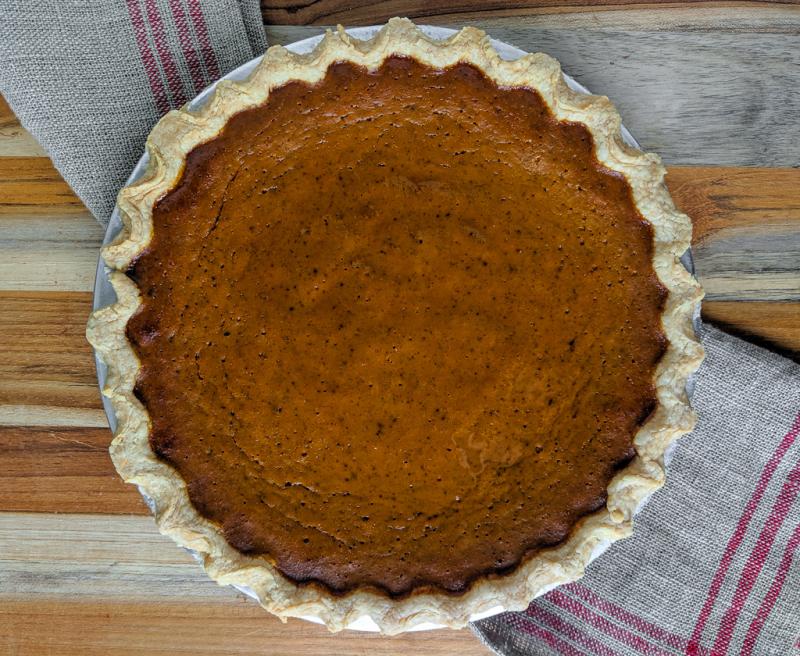
We’re happy to carry on the tradition here at the Bakehouse. Our Classic Pumpkin Pie may look wholly different than the pumpkin stews and custards of yore, but it’s just the thing that adorned our Thanksgiving tables as children. We deck out our pumpkin filling with Indonesian cinnamon, ginger, clove, Michigan honey, Guernsey Dairy cream and a cozy touch of Muscovado brown sugar to round it out. It’s a rich, creamy, and decadent celebration of a very storied gourd!
The post How Pumpkin Pie Became a Thanksgiving Classic appeared first on bake blog.
]]>The post Hurray for Holiday Challah! appeared first on bake blog.
]]>The religious roots of challah, a word derived from Hebrew, meaning “portion,” extend as far back as the Bible, where, according to Jewish culinary historians, Phyllis and Miriyam Glazer, in The Essential Book of Jewish Festival Cooking, “it refers to the portion of the dough consecrated as a gift for God, and given to the priests of the Temple in Jerusalem before every Sabbath. To this day, traditional Jews consider it a mitzvah* for women, baking bread in the home, to break off a portion of the ready-to-be baked challah dough and throw it into the oven flames, as a way of both reenacting the ancient Temple rights and acknowledging that the bread—all physical sustenance—is ultimately a gift of the divine.”
*This is an honorable task performed to observe a religious commandment.
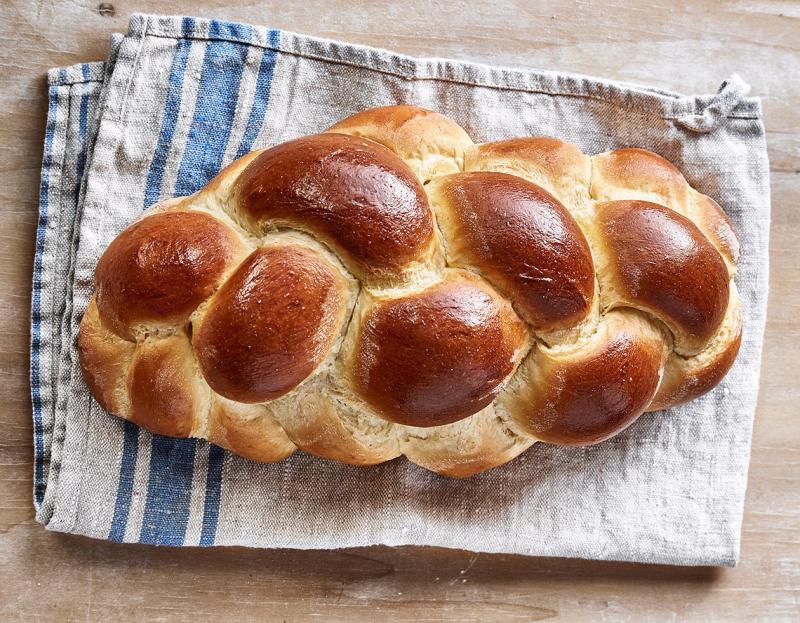
Challah baked for the Jewish Sabbath and holidays are made in various sizes and shapes, all of which have symbolic meaning. Braided loaves, which may have three, four, five, or six strands, are the most common and grace many a Shabbat table. On the night before the Sabbath, at sundown, a blessing is said over two such loaves, symbolizing, notes Claudia Rodin, author of The Book of Jewish Food, “two portions of the manna that was distributed on Fridays to the children of Israel during their Exodus from Egypt,” so they wouldn’t have to forage for food on the Sabbath. The loaves are covered on the table by a white napkin, which, Rodin further notes, “represents the dew that collected on the manna in the morning. Poppy and sesame seeds sprinkled on the bread also symbolize the manna that fell from heaven.”
For Rosh Hashanah, the Jewish New Year and the first of the High Holidays, the celebratory challah takes the traditional shape of a round turban and is often studded with raisins. The spiral shape, where there is no beginning or end, symbolizes continuity and the circularity of life. The loaves are often sweetened with honey, signifying the wish for a sweet year, richness and good living, and a nod to the Biblical references to Israel as the “land of milk and honey.”
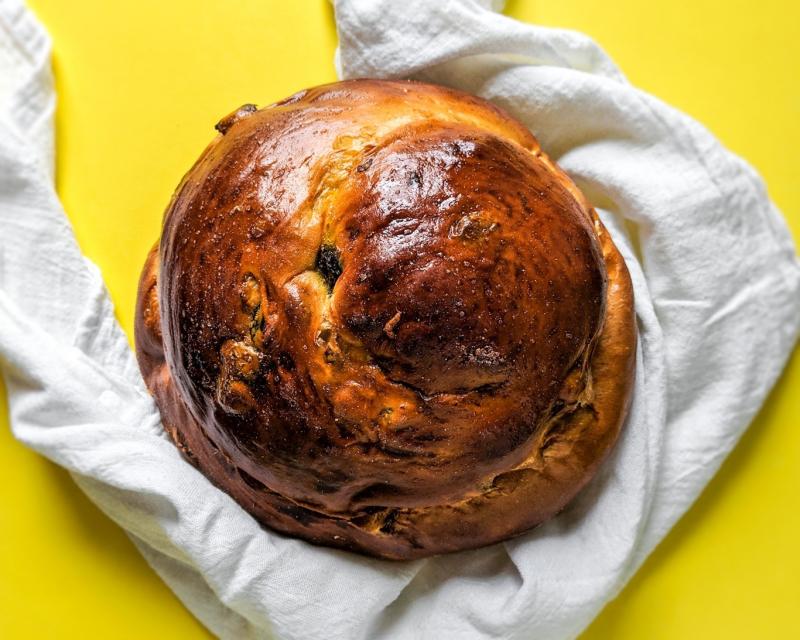
Here at the Bakehouse, we make our challah in the Ashkenazi Jewish tradition with organic wheat flour, fresh cage-free eggs, local Michigan honey from Gearig Apiaries Honey, yeast, and a little corn oil. The flavor is rich, but not too sweet. The texture is soft, but stands up to sandwiches, French toast, and bread pudding. It’s available in gorgeous, toasted saffron-colored braids, per Jewish tradition, or pan loaves we call “squares,” as well as in jumbo sandwich loaves.
During the Jewish High Holidays, starting with Rosh Hashanah, we pull out the stops with two rather fancy celebratory challahs, also rooted in centuries-old Jewish tradition. On order from September 26th through October 8th is our Ashkenazi turban-shaped challah studded with rum-soaked, red flame raisins, together with our more Sephardic-leaning five-strand Moroccan braid, flavored with sesame, poppy, and aromatic anise seeds and brushed with a honey syrup to give it a touch of extra sweetness. Here at the Bakehouse, we often refer to the Jewish High Holidays as “Challah Daze!,” due to all the traditional challahs we make at this time.
By Lee Vedder, Bakehouse Historian
First photo by Antonis Achilleos
The post Hurray for Holiday Challah! appeared first on bake blog.
]]>The post Cream of Wheat appeared first on bake blog.
]]>Delicious and ruddy
With pleasure, I relished
That my hunger has perished.
From Porridge Nursery Rhymes by international poet, Goodness Lanre, 2013
With whole grains at the forefront of our mission, it seems only fitting for the Bakehouse to delve into the world of porridge. And what a fascinating world it is!—with its long culinary history stretching back to the Agricultural Revolution of the Neolithic Era (between 8000 and 5000 BCE), and the countless variations of the hot, whole-grain cereal that people all around the world have been concocting ever since. Throughout history and within every culture, porridge has been a dietary staple. As one historian of early human history, Alistair Moffat, proclaimed a few years back, “The great invention, the greatest revolution in our history was the invention of farming. Farming changed the world because of the invention of porridge.”
For many around the world, porridge (also historically spelled porage, porrgie, parritich), represents nourishment: whole-grain goodness, healthy nutrition, and ultimate comfort, served up in a bowl. An added bonus is that it’s easy to make—simply boil or bake ground, crushed or chopped whole grains in water or milk. As food writer, Mary Luz Mejia, notes, “A big bowl of porridge can rev your internal motor at breakfast, help you unwind after a late night, or ease the previous night’s excesses. It can be made sweet, savory, thin or thick, with toppings or without. The only rules for entry into the ‘porridge club’ are that it needs to be made with a grain and it’s usually a dish best served warm to hot.”
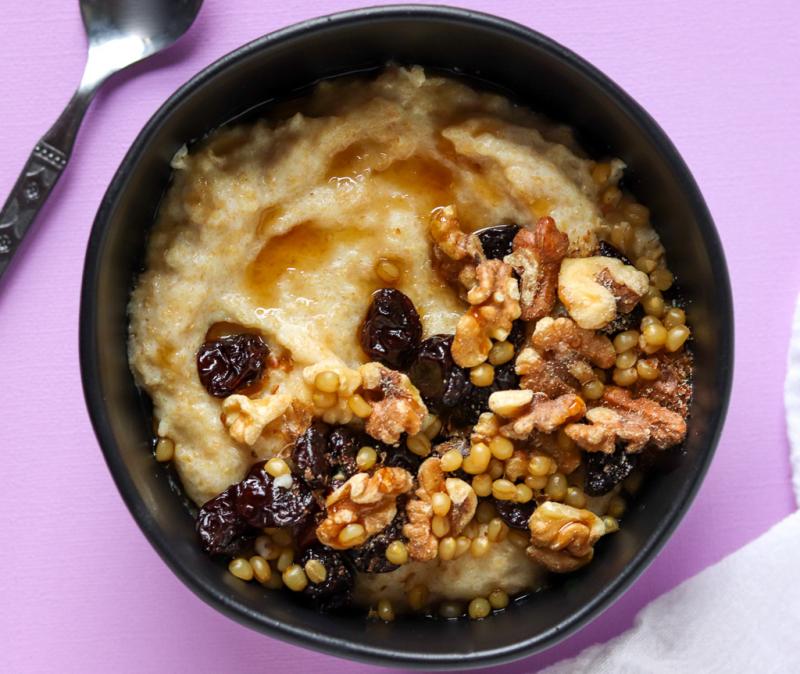
The most humble and universal of dishes, porridge was our first and simplest way of cooking grains to release the arsenal of nutrition and burst of flavor locked inside. Grains, served up as porridge, fed our earliest civilizations and “sustained empires because they were powerhouses of nutrition, relatively quick to plant and harvest (unlike fruit and nut trees), easily stored in cold, drought, or rain, and capable of feeding armies,” so notes Rachel Laudan, author of Cuisine and Empire—a sweeping chronicle of the rise and fall of the world’s great cuisines. “The early Romans built their empire on barley porridge,” she says. In Asia, “the Chinese built theirs on rice porridge, the Indians on rice and lentil porridge.” The list of grain porridges throughout world history is prolific and global: in Scotland and Ireland, barley and oats; in America, oats, wheat, and corn grits; in Asia, rice; in Russia, the pseudograin, buckwheat; in Norway, rye; in Africa, millet, corn, and sorghum; in Italy, corn and millet polenta, to name but a few. Within the rich, diverse histories of food in every culture, almost everyone eats porridge; it has been and continues to be the everyday food of everyday people.
Wheat Porridge in the American Midwest – A Brief History
From babyhood to old age CREAM of WHEAT brings a smile of welcome.
Palatable, wholesome, nourishing, good at all times for all people.
Served in many tempting forms, — dainty breakfasts, delicious desserts.
CREAM of WHEAT CO., Minneapolis, Minn.
Cream of Wheat print advertisement, 1909
…When was the last time you cooked your old friend Cream of Wheat?
…Remember the mornings you woke up to a light new taste that lets the flavor shine through. It’s as good as you remember, Cream of Wheat
Nostalgic Cream of Wheat television commercial jingle, 1970s
Here in the United States, porridge has been a nation-wide breakfast staple since the late 19th century. Among the hot breakfast cereals to take America by storm in this period was farina, a form of milled wheat made from the germ and endosperm of the grain, which is milled to a fine consistency and then sifted. The porridge, branded Cream of Wheat® in 1893, was created by a group of enterprising millers based, initially, in Grand Forks, North Dakota and, eventually, in Minneapolis, Minnesota. Cream of Wheat started in a very small way, but with a sound idea and the vision and determination to build a successful and worthwhile business.
The story goes that Emery Mapes (b. 1853), a former newspaper publisher, printer and editor, decided in 1889, with his partner George Bull, a Grand Forks farm manager, to go into the milling business in Grand Forks by purchasing the milling machinery from the Diamond Flour Mill, after a fire destroyed the company’s milling facility near Mankato, Minnesota. Knowing nothing about the milling craft, the two partners hired Tom Amidon, an experienced miller, to supervise the operation of their facility as head miller.
As the Grand Forks Diamond Flour Mill struggled to find its footing in the dark days leading up to the Economic Panic of 1893, Amidon came up with the idea of producing for profit, a “breakfast porridge,” made from milled farina, the whitest part of the wheat, which he had taken home and cooked into a cereal for his family, much to their liking. The milling partners, Mapes and Bull, loved the porridge’s delicious taste and creamy smooth texture, prompting them to name it, “Cream of Wheat.”
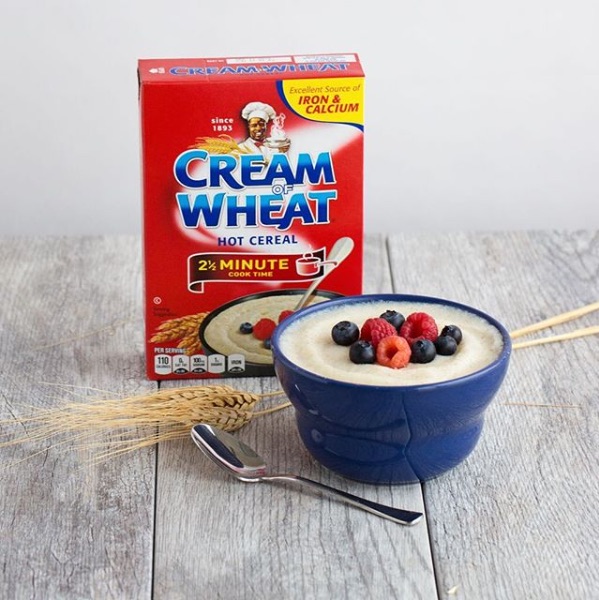
Confident they were on to something, the partners then agreed to let Amidon pack some of the cereal and ship it to their New York brokers, Lamont Corliss & Company. With the milling company barely afloat, financially, at this time, Amidon was left to his own devices in preparing the cereal for shipment; he cut the cardboard for the cartons by hand, labeled the packages himself, and crated them in wooden boxes he made up from waste lumber. With no money to spend on package design, Mapes, a former printer, drew upon his stock of old printing plates for an appealing illustration to brighten up Amidon’s makeshift cereal cartons. The image he settled on, which he ended up creating himself, happened to be a figure of an African American chef holding a saucepan over his shoulder, the precursor to the present-day, widely-known Cream of Wheat trademark personage.
In October 1893, the Diamond Flour Mill sent 360 boxes of Cream of Wheat to New York, along with a carload of milled flour. Within 3 hours of the shipment’s arrival, the New York brokers sent a telegram to the Grand Forks mill stating, “Never mind shipping us your flour. Send us a carload of Cream of Wheat.” To fill this order of nearly 2000 boxes, and even larger shipments in the future, the Mill came up with a strategic plan that entailed renaming their enterprise the Cream of Wheat Factory and packaging the cereal in assembly-like fashion so as to maximize the number of boxes they could churn out daily. They also enlisted Melvin Brannon, a biology professor at the University of North Dakota, in developing an electrolysis treatment to eliminate contaminants and provide longer shelf life for the cereal.
1893 also saw Cream of Wheat making its manufacturing debut, to great popular fanfare, at the World’s Columbian Exposition in Chicago. To generate further national interest in their new cereal, not to mention market share, Mapes began running ads for Cream of Wheat in the Ladies Home Journal in November of 1896, promoting an image of wholesomeness, family, home, and security; this message, published as illustrated print ads in scores of national magazines, went on to become one of the most successful and transformative cereal advertising and marketing campaigns of the early 20th Century. The demand for the new cereal was extraordinary, so much so, that by 1897 it had outgrown the producing capacity of the small plant in Grand Forks. The company thus relocated the Cream of Wheat Factory to Minneapolis, which had become a major grain hub and distribution center for the growing cereal market. Cream of Wheat had arrived, giving oatmeal a run for its money as America’s favorite hot breakfast porridge!
Wheat Porridge – Some Local Michigan History
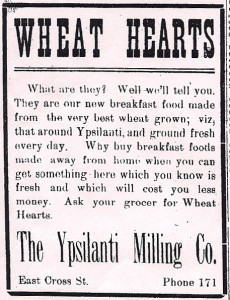
On a more local note, a perusal of the Ypsilanti Daily Press in August 1909 reveals that the Ypsilanti Milling Company, located on Cross Street along the east side of the Huron River, sought to tap into the extraordinary success and popularity of Cream of Wheat with their own take on the creamy wheat porridge, which they branded as Wheat Hearts.
To promote the venture, which ended up being very short-lived, the flour mill ran the following advertisement in daily issues of the paper over the course of a week in August 1909 (August 9-16), never to be seen again:
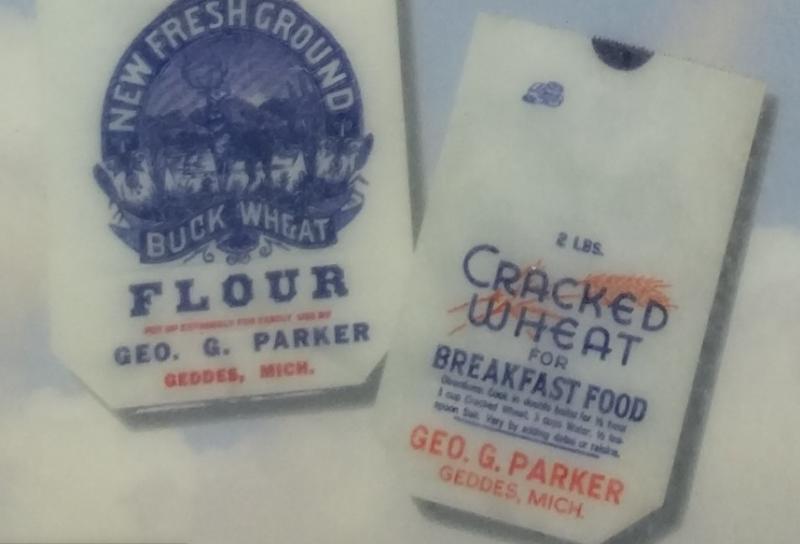
Around the same time that the Ypsilanti Milling Company was pitching their Wheat Hearts, in the daily paper, George Parker, in Ann Arbor Township, was transforming his father’s 1873 stone grist mill on Fleming Creek, off Geddes Road, from a family farm-based operation into a commercial flour mill. Beginning in 1910, following his father’s death, George milled, packaged, and sold to area grocery stores pancake mix, graham flour, buckwheat flour, cornmeal, and cracked wheat breakfast cereal, similar to Cream of Wheat, all under the brand name, “Parker’s Fleming’s Creek Mills.” The wheat cereal was packaged in 2-pound bags that bore a printed illustration of a couple of sheaves of wheat as the backdrop for the insignia and preparation instructions:
George continued to run the mill as a commercial enterprise until his death in 1956, at which point his son, Fred Parker, and other family members took over, but only for a few more years. By 1960, the mill had ceased operation and was sold, along with the family farm and other buildings on the property to the Frederick Mattael family. In 1983, the Washtenaw County Parks and Recreation Commission purchased the Parker Mill property and restored the mill back into full operation as the primary feature of Parker Mill Park, which opened to the public in 1984 and is still running to this day.
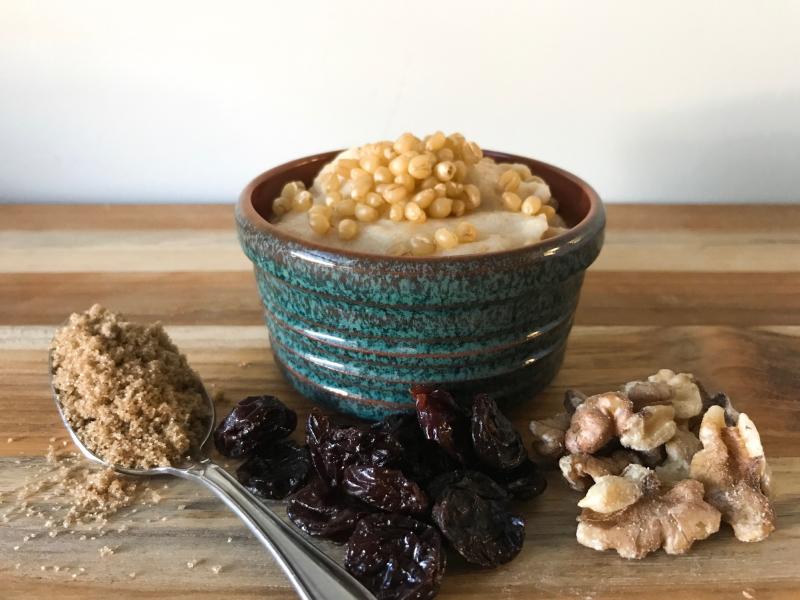
Now that we’re milling some of our own wheat at the Bakehouse on our stone mill, we decided to try freshly milled whole grain (FMWG) cream of wheat. It’s as comforting as the red box version and more flavorful because it contains the entire wheat berry. We are using coarsely milled, soft white wheat from Ferris Organic Farm in Eaton Rapids, MI and cooking it with local Guernsey Dairy milk. Come in and try some—it’s delicious with toppings or just on its own. But if embellishment is your thing, we currently have on hand Michigan dried cherries, California walnuts, Michigan maple syrup, muscovado brown sugar, milk, and cream to top your creamy whole wheat porridge.
Watch for new porridges and more porridge history in the coming months.
By Lee Vedder, Bakehouse Historian
Cream of Wheat photo via their Instagram, Wheat Hearts ad via YpsiNews.com, Geo. G. Parker packaging via HMdb.org
The post Cream of Wheat appeared first on bake blog.
]]>The post Gateau St. Honoré appeared first on bake blog.
]]>
The torte’s namesake, Honoré, also known as Honoratus, became bishop of Amiens, in the north of France, in 554 AD. According to tradition, a number of miraculous events occurred during his service, which spared farmers, millers, and bakers from natural disasters. After his death, processions in his honor supposedly stopped both droughts and deluges, ensuring good wheat harvests. This won Honoré the admiration of bakers across France. In 1204, a Parisian baker built a chapel (no longer extant) to commemorate him, and in the 17th century, the French baker’s guild anointed him the patron saint of bakers and pastry chefs. In religious and popular imagery, Honoré is often depicted holding a baker’s peel—the flat wooden paddle used to move loaves to and from a hot oven—often with loaves of crusty French bread nearby and with bakers at work, in the background, kneading dough and manning wood-burning ovens.
Fast-forward to the 19th century, when Parisian pastry bakers began bringing glory to the saint’s name in the best way they knew how—with a fabulous show-stopping confection. The Gateau St. Honoré was developed at the legendary Chiboust pastry shop on Paris’ Saint Honoré Street, which, alas, no longer exists. It started out as a ring-shaped brioche filled with pastry cream that Chiboust lightened with an airy Italian meringue, creating a new kind of filling that came to be known as crème Chiboust, which French bakers still use. According to Parisian pastry chef, Pierre Hermé, one of Chiboust’s bakers, August Jullien, came up with his own version, replacing the ring of brioche dough with a ring of little cream puffs.

By the late 19th century, the Gateau St. Honoré had taken its present form, incorporating a disk of puff pastry filled with pastry cream, topped with a crown of cream puffs dressed up even further with a crunchy cap of caramelized sugar, and draped with swags of whipped cream. The plain version of the torte—simply flavored with vanilla and the bittersweet notes of burnt sugar—is most common, but you can find fanciful seasonal variations, showcasing everything from tropical fruits to green tea.
In modern-day France, the Feast of St. Honoré still survives as a time to appreciate all sorts of breads and pastries. French baker Dominique Geulin, who grew up in Normandy and is now based in Portland OR with his bakery St. Honoré Boulangerie, fondly remembers how bakers in France (including his parents) would open their doors on May 16 for community festivals, school field trips, and public demonstrations. The modern-day French baker’s organization, Confédération Nationale de la Boulangerie-Pâtisserie Français, also takes that week as the occasion to hold its annual meeting during a full-on festival of bread.

This fall, in October and November, BAKE!, the Bakehouse’s hands-on teaching bakery, is offering two classes on the Gateau St. Honoré, where you’ll learn all the classic French techniques—pâte feuilletée (puff pastry), pâte á choux (choux pastry), crème pâtissière (pastry cream), whipped cream, and caramelized sugar—that go into making this show-stopping dessert, a six-hour project well worth the effort! (Don’t worry, we provide a great Bakehouse lunch, too.) Any dessert that is built out of other desserts is a winner in our book and the Gateau St. Honoré is sure to impress your guests! (Check out the Bakehouse’s Instagram highlights for more behind-the-scenes shots from this class!)
By Lee Vedder
Bakehouse Historian
The post Gateau St. Honoré appeared first on bake blog.
]]>The post From Kipferl to Croissant appeared first on bake blog.
]]>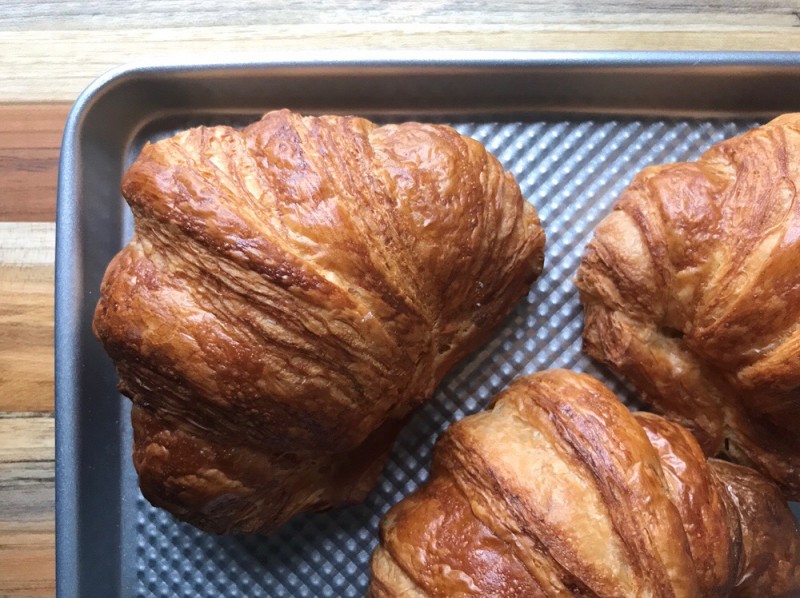
Culinary historians concur that the modern-day croissant was inspired by the Austrian kipferl, a crescent-shaped morning pastry made with brioche-like dough, which is denser and less flaky than the croissant we know today. According to popular lore, the kipferl originated in 1683 as a comestible celebration of Austrian victory over the Ottoman Turks at the siege of Vienna. The story goes that a baker, up early to make bread, saved Vienna when he heard the Turks tunneling underneath the city and sounded an alarm to the Viennese authorities. The kipferl’s curved shape, said to mimic the crescent moon of the Ottoman flag, would then seem to pay poetic tribute to the indomitable spirit of a city that resisted a powerful invading force. But the kipferl existed long before the Ottoman siege of Vienna. A poem mentions it as one of the Christmas treats that Viennese bakers presented to Duke Leopold in 1227. Moreover, crescent-shaped breads in general date back centuries earlier.
So, does the croissant’s Austrian ancestry belie its French fame? “Of course not,” says Jim Chevallier, an independent scholar and author of a book on croissant history, August Zang and the French Croissant: How Viennoiserie Came to France. “The croissant began as the Austrian kipferl, but became French the moment people began to make it with puffed pastry, which is a [17th-century] French innovation,” says Chevallier. “It has fully taken root in its adopted land.” Order a kipferl in Austria or Germany today and you’ll likely be handed a crescent-shaped cookie.
A more romantic tale from the 18th century attributes the origin of the croissant to the French Queen and Austrian Archduchess, Marie Antoinette (1755-1793). Legend has it that the Queen, homesick for the taste of her native Vienna, would often bow out of royal dinners, only to sneak away to indulge in the sweets and coffee of her country. The story thus credits her love of Viennese kipferls and the christening of the kipferl as the “croissant” as having introduced the pastry to French high society.
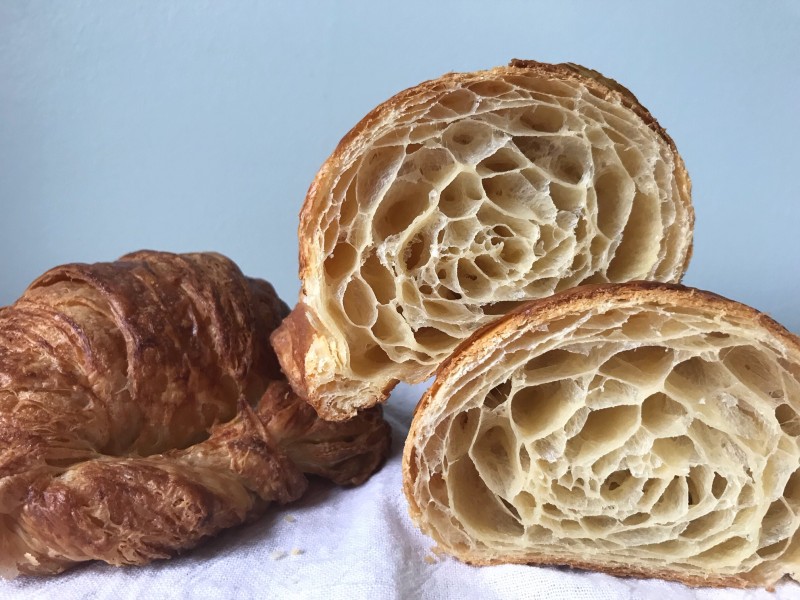
Legends aside, historical evidence as to the croissant’s evolution in France points instead to August Zang (1807-1888), an Austrian entrepreneur who opened the first Viennese bakery in Paris in 1838. Located at 92 Rue Richelieu on the Right Bank, his upscale Boulangerie Viennoise specialized in bread and pastries from his native Vienna, most notably the kipferl, along with pain viennois (a Viennese-style sandwich bread), both of which became widely popular in the city within ten years. Equipped with his patented steam oven, Zang made his kipferls with noticeably flakier dough than traditional brioche-based versions and the French began referring to the newfangled pastry as a croissant due to its crescent shape.
References to croissants made with true, yeasted pâte feuilletée (puff pastry dough), however, didn’t materialize until the early 20th century. For that development, we have the French baker, Sylvain Claudius Goy, to thank. In 1915, he wrote a recipe that specifically mentions pâte feuilletée, calling for the rolled puff pastry to be yeast-leavened and laminated with butter, a technique that remains at the core of how the modern-day, all butter, homemade croissant (croissant au beurre, fait maison) is made in France.
And it is this traditional French croissant we are dedicated to making here at the Bakehouse. Like bread and other baked goods in America, croissants can be made with shortcuts causing them to fall short of the intended texture and flavor. There are very few places in the world outside of France where you can get a truly great, flaky, buttery croissant—Zingerman’s Bakehouse is certainly one of those places. We pride ourselves on their rich flavor, tender honeycombed interior, and crispy exterior that shatters a little when you bite into it. It’s mostly about taking the time to do it right and not using fake ingredients or pre-made frozen doughs. And we think it’s well worth the time and effort to do so. Like we say, you really can taste the difference. Visit the Bakeshop to pick up our 4 variations on the French croissant: classic Butter, Juliette’s Almond, Chocolate, or Parmesan and Prosciutto.
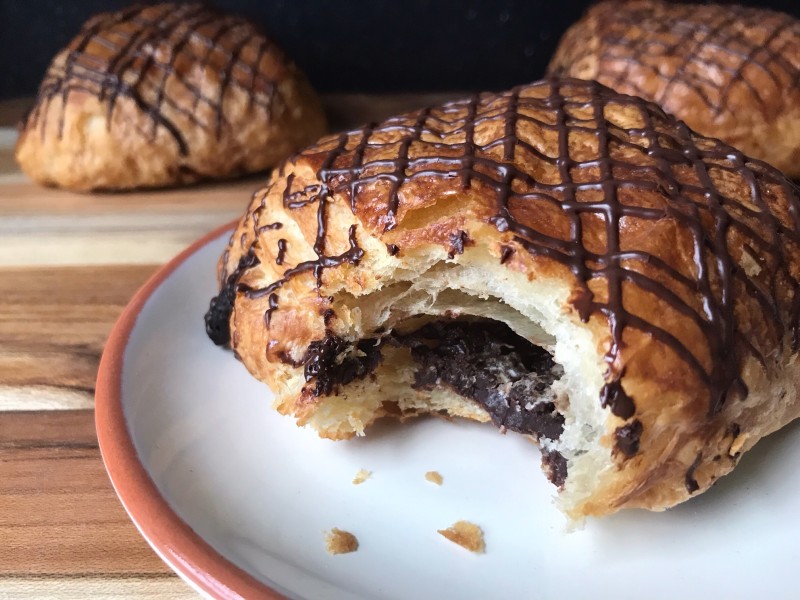
Or, learn to make croissants yourself in one of our most popular hands-on baking classes: Ooh La La Croissant: French Pastry Class. You’ll learn the key techniques for creating a butter-laminated dough (layering the dough with butter and folding it over), filling the croissants, proofing them properly to achieve the right texture, and finally, baking them to a rich golden brown. In class, you’ll make our butter croissant recipe, as well as fill them with both our rich almond frangipane (we’ll give you the recipe for that, too) and bars of intense dark chocolate imported to us in Ann Arbor from renowned French chocolatier Michel Cluizel. There are few more sublime things in our book than enjoying a freshly-baked croissant that is still a little warm. We can’t wait for you to try it. It’s going to be life-changing. Reserve your spot now.
By Lee Vedder
Bakehouse Historian
The post From Kipferl to Croissant appeared first on bake blog.
]]>The post Summer’s Perfect Pair appeared first on bake blog.
]]>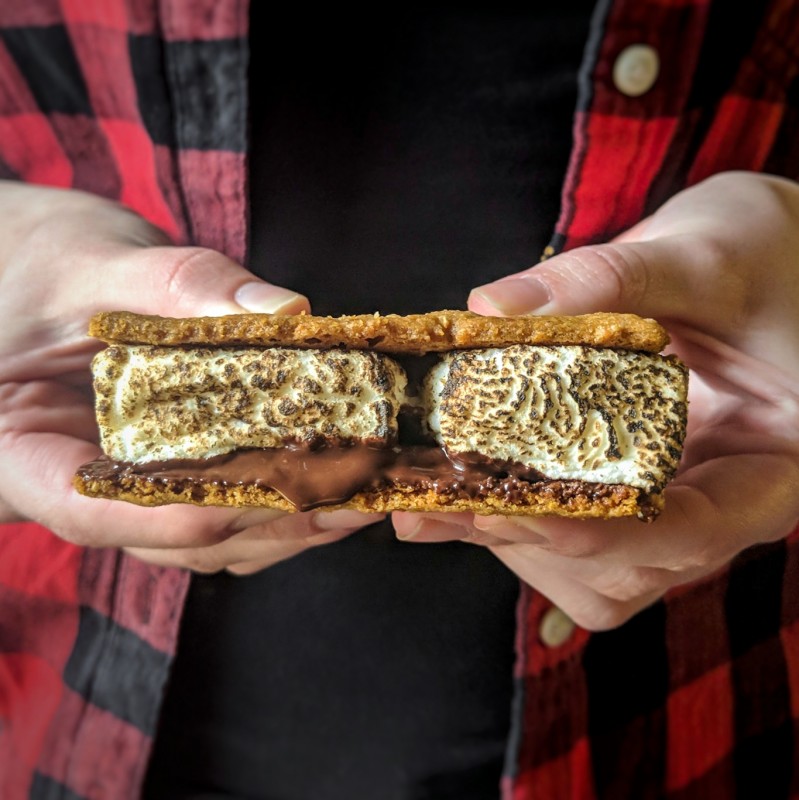
No self-respecting s’more is complete without a perfectly crisp graham, so we’ll deliver the graham cracker your campfire treats deserve. Nostalgic for this American childhood favorite, we wondered what would happen if we changed up the recipe for graham crackers using great ingredients. What we created was an intensely flavored cookie more addictive than what we munched on as kids. In the spirit of constant improvement, we further wondered how we could make these crowd favorites even  tastier. Lo and behold, the flavor boost obtained from milling our own flour from organic soft white wheat grown in Michigan was the easy answer! We love the crackers’ amped up flavors of toasted wheat, honey, and ginger—not to mention their more hearty, crisp texture—and you will, too!
The original “Graham” cracker was not the tasty sweet treat we know and love today; it was a bland, unsweetened biscuit made from finely ground, unbleached wheat flour, wheat bran, and coarsely ground germ, which also came to be known as “Graham bread.” First conceived in the 1830s, the crackers were consumed as part of a strict vegetarian and fiber-rich diet developed by the crackers’ namesake, the Reverend Sylvester Graham (1794-1851), an eccentric Presbyterian minister from Connecticut who became a social reformer and ferocious advocate of healthful living during America’s health craze of the 1820s and 1830s.
Exercising some combination of pseudoscience and faith, Graham believed that physical lust was harmful to the mind, body, and spirit and that a healthy diet, devoid of meat, fat, spices, and refined white flour, would aid in suppressing sinful carnal excess, which he saw as a genuine human affliction and the scourge of his time. His preaching and promotional writings on maintaining a healthy, plant-based, fiber-rich diet for physical, mental, and spiritual well-being won countless converts over the course of the nineteenth century, who came to be known as “Grahamites.”
So, Dr. Graham, thanks for making graham crackers. Now, if ya don’t mind, step aside and let us take them to a new level! Enjoy our crisp, flavorful, and not-too-sweet crackers. They’ll take you right back to those summer campfires.

Pick up our Graham Crackers and Zingerman’s Candy Manufactory’s Marshmallows (Vanilla or Chocolate) in our shop, or take our Graham Crackers and Marshmallows class at BAKE!, our hands-on baking school.
In class, we’ll have fun making chocolate and vanilla marshmallows and learning how to make up our own flavors. Strawberry marshmallows? Mint marshmallows? Birthday cake marshmallows? You betcha. Any marshie you can dream up, you can make. You won’t believe the difference between your homemade marshmallows and the packaged varieties of your childhood. Join us and increase the flavor of your s’mores by 100% and go home with a dozen graham crackers, chocolate and vanilla marshmallows, graham cracker dough to bake later, and great coupons.
Photos by Emily Hanka (1 & 3), and Antonis Achilleos (2)
The post Summer’s Perfect Pair appeared first on bake blog.
]]>The post Stone Milling Idioms (We Say Them All the Time!) appeared first on bake blog.
]]>
Listed below are some of the more common mill sayings and proverbs, together with an explanation of their point of origin:
First come, first served ~ This was the law for millers in many countries. Because it could take days for a farmer to have his grist ground, the law was designed to prevent impatient customers (or those receiving special treatment from the miller) from queue jumping.
Grist for one’s mill ~ Since wheat and corn are ground by ‘teeth,’ the grinding stones ‘chew’ the grist into flour; thus to ‘chew’ over something became a thought or idea to ponder.
The daily grind ~ The repetitive nature of milling led to the concept of ‘the daily (same old) grind.’
Run of the mill ~ The ordinary, daily grind.
Keep your nose to the grindstone ~ If set incorrectly, millstones could grind too hot and the flour would become cooked, emitting a burning smell. Occasionally, flour would burst into flames. The miller kept his ‘nose to the grindstone’ to detect the temperature and condition of the meal—and because most stone mills were made of wood, they could (and frequently did) burn to the ground in a matter of minutes.
Rule of thumb ~ To test the quality and grind of the flour, the miller would take a pinch of it between his thumb and finger. If too coarse, the flour would be ground again.
Put your shoulder to the wheel ~ When a miller had to turn a windmill into the wind, he ‘put his shoulder to the wheel’ by pushing the wheel at the bottom of the mill’s tail pole. Some tail poles had a yoke for the miller’s shoulder. Some millers used a horse. This saying is now taken to mean ‘make an effort.’
Three sheets to the wind ~ A (four-sailed) windmill with only three of its sails covered in ‘sheets’ of canvas will turn clumsily because it is off balance. Thus, the term is applied to drunks.
Fair to middling ~ The quality of ground meal would be fair, middling, or fine. To be ‘fair to middling’ is to be below one’s best.

Millstone round your neck ~ Millstones are very heavy and a millstone around your neck is a problem that prevents you from doing what you want to do.
Put through the mill ~ means to be exposed to hardship or rough treatment, just like being ground in a mill between stones.
Show your metal ~ Millstones often needed to be dressed (re-carved). When a miller hired an itinerant dresser, he could tell whether the man was experienced by noting the slivers of metal (thrown off from his carving tools) embedded in his hands. A variant of ‘show your mettle.’
Take your turn ~ To ‘take your turn’ is to be the next person to have corn or wheat ground by the turning of the millstones.
All is grist for the mill ~ meaning everything can be made useful, or be a source of profit.

And for a few lesser-known mill-related proverbs:
-
the mills of God grind slowly, yet they grind exceedingly small (Retribution may be a long time in coming, but it cannot be avoided)
-
much water goes by the mill that the miller knows not of (Many things are stolen or go astray without the knowledge of the person affected)
-
the mill cannot grind with the water that is past (time lost cannot be recalled, seize the day, there’s no time like the present)
By Lee Vedder
What’s next at the Bakehouse with freshly milled whole-grain flour?
We’re looking forward to introducing many new Bakehouse breads and sweet stuff made with freshly milled whole grains this year. At the end of next week, look for updated versions of our Funky Chunky cookies, blueberry muffin, and Volkornbrot, as well as new Orange & Date Scones and Michigan Double Cookies. And stay tuned for more to come—our list of ideas for new and improved breads is a page long!
The post Stone Milling Idioms (We Say Them All the Time!) appeared first on bake blog.
]]>The post The Grass-Fed, Mediterranean-Style Yogurt We’re Hooked On appeared first on bake blog.
]]>With this new addition to the Bakeshop, you might be wondering why we’re so taken with Hiday Family Farm yogurt. Here at the Bakehouse, we pride ourselves on sourcing local ingredients from Michigan farmers who care about sustainable practices. Dan Hiday, the owner and principal farmer of the Hiday Family Farm, fits this bill to a T and we’ve been carrying pints of his organic, grass-fed yogurt in the Bakeshop for close to a year now. Dan’s evolution from conventional cattle farmer to organic dairy farmer is an inspiring one and his yogurt, now a Bakeshop staple, is a flavorful testament to his steadfast dedication to grass-based, sustainable farming and animal husbandry.

Dan founded his 155-acre family farm back in 1987, raising beef cattle primarily on grain, utilizing conventional farming methods. Six years later, in 1993, he switched course and became an organic cattle farmer; he sold all his grain equipment, stopped using chemicals, pesticides and herbicides and converted his entire farming operation over to a natural grass- and pasture-based system. In an article last year for the Battle Creek Enquirer, Dan recalled what propelled him to make the conscientious decision to go organic, long before it was deemed desirable, practical, or wise to do so:
“I just got to thinking about, OK, all these chemicals I’m putting on this farm, where’s this stuff going? Is it going down to groundwater? Are my kids consuming this? And I just became concerned, one, about my family and their health, two, the land that I was farming and the animals that I was raising.”
Since then, Dan and his family have been raising their cattle on wide-open, lush salad-bar grass pastures free of pesticides and herbicides. Four years ago, Dan put his organic farming chops to the test, yet again, when he sold off some of his beef cattle to make room for a small herd of dairy cows, having decided to make a go of it in the organic dairy industry. With the recent decline of milk sales nationwide, Dan, ever the resourceful farmer, has focused his efforts instead on making some of the best local organic, grass-fed Mediterranean-style yogurt around.

So what makes Hiday Family Farm yogurt so special and delicious? Well, to put it simply, it’s a thick, creamy, and refreshing bite of healthy, organic, fermented milk from happy, pasture-raised, grass-fed dairy cows. Nothing is added to the grass-fed milk and milk cultures and it’s made in very small batches. Quantities are thus limited, so we feel very fortunate to have it available in the Bakeshop for you all. It’s outstanding flavor and nutritional punch won’t disappoint. Because it’s made from the milk of grass-fed cows, Dan’s yogurt is of a much higher quality and is richer in omega-3 fats and CLA, a powerful fatty acid known as conjugated linoleic acid. Moreover, according to a recent study in the Journal of Food Science and Nutrition, the unique balance of omega-3 and CLA fatty acids found in grass-fed milk can potentially reduce the risk of cardiovascular and other metabolic diseases. And Dan’s nutrient-rich yogurt tastes incredible. Testimonials on just how delicious it is abound on the farm’s Facebook page.
So come to the Bakeshop and pick up some pints of Hiday Family Farm Mediterranean yogurt or indulge in our bright Meyer Lemon Yogurt cups for a tasty snack—to satisfy your body and your culinary soul!
By Lee Vedder
First photo from Hiday Family Farm’s Facebook page
The post The Grass-Fed, Mediterranean-Style Yogurt We’re Hooked On appeared first on bake blog.
]]>The post Washtenaw County’s Early Milling History appeared first on bake blog.
]]>
Damming streams and building water-powered sawmills and stone grist mills were among the most important tasks in any frontier settlement bolstered by agriculture. Many of the folks who came to settle Washtenaw County in the 1820s and 1830s were seasoned grain farmers and millwrights from the bread basket and wheat-growing regions of New York and New England, their arrival facilitated by the opening of the Erie Canal. Beckoning them to the area, apart from their pioneering spirit, was the Huron River, with its myriad tributaries, and its fertile valley, which became by the mid 19th century one of the most productive wheat-growing regions in the country.
The Huron River, with its steep gradient of 200 feet from Portage Lake to Rawsonville, and 42 feet within the city of Ann Arbor, proved a highly advantageous source of water power that millwrights were quick to harness, building saw mills and stone grist flouring mills all along its banks, just as the surrounding valley was being deforested and cleared for agriculture.

Neighboring tributaries, including Allen’s Creek, Fleming Creek, Traver Creek, and Mill Creek, were also utilized as power sources. By the mid 19th century, water-powered grist, saw, woolen, paper, pulp, plaster, and cider mills occupied more than 50 sites along the Huron and its tributaries throughout Washtenaw County. Indeed, so many mills were built along the western reaches of the Huron, Clinton, and Raisin at this time that the area was called the “power belt.” Within the first five years of county settlement, Ann Arbor, alone, was home to a number of saw and stone grist mills:
-
In the summer of 1824, Robert Fleming built a saw mill on Sec. 25 (north of Huron River at Gettysburg). Today this is just east of the intersection of Dixboro and Geddes Roads on Fleming Creek. In 1826, John Dix’s stone grist mill joined the saw mill on Fleming Creek.
-
John Geddes and his brother, Robert, constructed a saw mill almost directly across the river from the Fleming Mill, commencing operations in March 1829. It was around the Geddes mill that a small area settlement gradually coalesced.
-
In 1825 Andrew Newland built Ann Arbor’s first saw mill at the north end of N. State Street. The race for this mill—that is, the narrow channel constructed off the dam or mill pond to funnel a swift and powerful current of water to the mill’s power-generating water wheel—was on the south side of the river and must have come from the Allen’s Creek mill race.
-
In August of 1826, George W. Noyes built a grist mill on N. Main Street, run by water from Allen’s Creek.
-
During 1829-30, Anson Brown built the flouring mill of Swift and Co. and the dam and mill race at Argo to power it.
-
Ann Arbor’s co-founder, John Allen, dammed his namesake creek just south of Huron St.; the mill race ran west of the creek down to just below Argo Dam, where it powered the City Mill, a flour mill a little north of the corner of Main and Depot;
-
Later, in 1873, William Q. Parker built a grist mill over the foundation of the old Fleming saw mill on Fleming Creek, which had since gone to ruin, to produce corn feed for his adjacent 61-acre family farm (between Geddes Road and the Huron River). In 1910, after William’s death, his son George took over the operation of the stone grist mill, expanding it to a commercial flour mill which sold pancake mix, graham flour, buckwheat flour, cornmeal, and cracked wheat breakfast cereal to area stores, up until 1959, when it ceased commercial operations following George’s death. Still standing today and fully operational, the Parker Mill is a well-preserved example of the small-scale, family-run, combination farm-and-grist-mill operation that was so prevalent in the county and across southeastern Michigan in the 19th century.

Along with Ann Arbor, Ypsilanti became another major milling hub for the county, likewise beginning in the 1820s, when the area was first being settled. By the 1840s, the town saw the construction of at least six flour mills on the Huron River:
-
Woodruff’s Flour Mill – Constructed in 1824-1825, south of Ypsilanti, by Major Benjamin Woodruff, the mill was in operation until 1839. No dam was constructed as the mill was sufficiently powered by a natural waterfall of 11 feet, which was claimed to be the third best power on the Huron.
-
Hardy & Reading’s Saw Mill and Flouring Mill – The first mill-dam in Ypsilanti was that of Hardy & Reading, built in 1827 at the corner of French Claim 691 and the southwest quarter of section 4 of Ypsilanti Township. The dam, made of brush, clay, and logs, was more likely the work of the “beaver tribe,” than of “enterprising men,” as one local historian noted in the 1880s. The dam washed away in the flood of 1832, with the woolen mill’s dam located at that point later on. While the mill first built at this site was a saw mill, Hardy & Reading also built a flouring mill nearby in 1828; that mill burned in 1851.
-
Harwood’s Flouring Mill – Ypsilanti’s third flouring mill was constructed in 1829, by W. W. Harwood, just south of Congress Street, on the left bank of the Huron. By 1888, ownership of the mill had changed many times and was renamed the Huron Flouring Mill by the Deubel Brothers. (The Deubel Brothers are likely the same Deubels who owned the Swift Deubel & Co. mill in Ann Arbor in 1872.) The mill had also been modernized, sporting “six run of stone, turbine water wheels, and all modern improvements,” producing 15,000 barrels of flour annually for the Detroit and Eastern markets, and grinding another 24,000 bushels of grain for local patrons. The mill, in 1888, was valued at $20,000.
-
Eagle Flouring Mill – In 1839-40, Arden H. Ballard purchased the site of Hardy & Reading’s Saw Mill, along with water rights, and constructed a flour mill at that location. Later owners of this mill included Dr. Clarke of Detroit, 1843; Thomas O. Hill, 1848; Mark Norris and Benjamin Follett, 1850; and Lyman D. Norris and Chauncey Joslin, 1853. In January of 1856, Joslin bought out Norris, becoming the sole proprietor of the Eagle Mill, as well as the Ypsilanti Flouring Mill. In October of 1856, the Eagle Mill burned, apparently after a shipping mishap by the Michigan Central Railroad, which delivered a 30-day backlog of grist to the mill in only 3 days. The fire cost Joslin over $10,000.
-
Ypsilanti Flouring Mill – Built in 1839-40 by Mark Norris, the mill possibly occupied a site at the opposite end of the dam used by the Eagle.
-
AEtna Mills – At some point in the 1840s, Timothy Showerman purchased Hurd & Sage’s Iron Foundry and converted it into a flouring mill. Hurd & Sage had leased a quantity of water power from Mark Norris, but Showerman utilized additional power, resulting in legal proceedings and the stoppage of AEtna. As a result, the mill came to be owned by Norris & Joslin, who converted it into a sash, door, and blind factory, later adding a planing mill, ax-handle factory, and gypsum mill, before the June 1858 floods on the Huron washed the entire operation downstream, at a loss of $12,000.
As is evident from the stories of these local mills, the milling business was not an entirely safe enterprise. Mills during the 1800s faced two major challenges: fires and floods. If they were not destroyed by one they were destroyed by the other. Flour dust from stone grist milling was highly combustible and could ignite and explode when exposed to flame and/or excessive heat. Flooding along the Huron and its tributaries wreaked havoc on the mills’ hydropower system, washing out dams and destroying the mill races, water wheels, and turbines that powered all the milling machinery, including the all-important millstones.

Is stone milling the most efficient way to grind flour? No, but it feeds our soul and hearts by connecting us to our history when it was the primary mode of milling grain in southeastern Michigan.
And have we mentioned the flavor and nutritional benefits? Okay, we have, but it bears repeating. When grain is ground between two millstones, the whole seed kernel—its exterior bran, starchy endosperm, and oily germ, the grain’s nutritional powerhouse—is crushed and combined to create flour that is not only rich in fiber, omega 3s, and nutrients, but is also intensely flavorful.
From Lee Vedder & the Bakehouse Grain Commission
Check out our Special Events line-up for further local and historical learnings, like Jae Gerhart’s discussion about what the growing market for local food looks like in Washtenaw County and the surrounding foodshed, and Dr. Maria Trumpler’s talk about why women stopped baking bread at home (and why it matters).
The post Washtenaw County’s Early Milling History appeared first on bake blog.
]]>The post Early American Mill Design & Their Role in Local Communities appeared first on bake blog.
]]>
The water-powered, stone grist flouring mills built in America during the first half of the nineteenth century were multi-storied structures that housed customized variations of the revolutionary, automated stone-milling system developed by Oliver Evans of Delaware in the 1780s. In his Young Mill-Wright and Miller’s Guide, published in Philadelphia in 1795, Evans laid out his continuous water-powered system of elevators, conveyors, gears, belts, and millstones and other automatic devices to move grain and flour through all the steps in the stone milling process—weighing, cleaning, grinding, cooling, sifting and packing—by mechanical means, with little need for manual labor. An article in the Dexter Leader in 1874 summed up the complexity of the local miller’s task at the Scio Flour Mill in Scio Township on the Huron River: “To follow the grain as it hurries hither and thither, up and down, until it is cleaned, and ground, and purified, and the flour is separated from all dross, and is ready to pack and ship, is too bewildering for any mind but the dusty miller’s who knows all the intricacies of its ways.”
Evan’s automated system revolutionized the American milling industry and was the driving force behind the design and construction of water-powered stone grist flouring mills in the nineteenth century throughout Washtenaw County. Powered by water wheels and/or turbines, their operation supported a thriving local grain economy focused on the cultivation of wheat, buckwheat, and corn. Farmers, who needed access to a mill within a day’s travel by horse-drawn wagon, brought their grain to be ground into flour, meal or feed for their livestock. They would pay a “toll” in grain, which the millers, in turn, would grind the grain and sell the flour to their local communities. Beyond their functional purpose, the stone grist mills also contributed to the social fabric of the agricultural and town communities throughout the county. They served as social gathering places where farmers, with their families, would congregate on at least a weekly basis to not only mill their grain but also to vent frustrations, exchange ideas and escape the isolation of farm life.

With this vast history of local stone milling, we, at the Bakehouse, feel honored and are humbled to try our hand at it with our own small electric powered stone mill from Andrew Heyn. We recognize that we’re not professional millers and hope to take this opportunity to work more closely with current Michigan millers.
The Bakehouse and Local Michigan Mills
Milling has lived on in Michigan. We’ve had the good fortune to work with many fine Michigan millers and milling companies over the last quarter century.
Daily Grind, Ann Arbor, MI
During the Bakehouse’s first eight years of operation (1992-1999), we were lucky enough to buy our organic grains from the Daily Grind, a mill initially owned by the Michigan Federation of Food Coops, located right here in Ann Arbor on Felch street, where the Ann Arbor Distillery is today. The Daily Grind used a hammer mill and once a week we’d drive there in our van and pick up whole wheat, whole rye, and cornmeal for our baking. The Michigan Federation also had a warehouse, People’s Warehouse, which sold Michigan-grown organic grains, beans and flour to co-ops nationwide. In 1992, after major operating losses, the Michigan Federation dissolved, and they voted to consolidate with North Farm Co-op. The warehouse subsequently closed, but the Daily Grind mill continued for several years, eventually relocating to Mason, MI, where we’d then drive every couple of weeks to pick up flour.
Westwind Milling Company, Swartz Creek, Michigan
From 2009 to 2015, we purchased high extraction, hard red spring wheat flour from the Westwind Milling Company, owned by Lee and Linda Purdy. In 2000, the Purdys bought the old Wolcott Mill in Argentine and renamed it Westwind Milling Company after their family farm, Westwind, which has been in operation since 1953. In 2016, the Purdys sold the mill’s building and land, but brought all the milling equipment and machinery back to the farm, which they now use to stone grind Michigan-grown, certified organic grains into flour and baking mixes. Also on their 120-acre farm, they grow, raise, and make a variety of organic farm products–eggs, baked goods, fiber products, and seasonal vegetables–using organic and sustainable practices. As the Purdys say: “We Grow It, We Mill It, We Bake It.”

Star of the West Milling Company, Frankenmuth, MI
Much of the pastry flour that’s gone into our brownies over the years has come from The Star of the West Milling Company. Based in Frankenmuth, MI, the company was founded over 170 years ago by two brothers, Johann Mathias and Johann Georg Hubinger, who were among Frankenmuth’s early settlers. Arriving in 1846, they soon opened their family milling business, which fundamentally changed the historical trajectory of Frankenmuth, originally an Indian missionary. Their first milling venture included a water-powered flour mill and sawmill that helped to ensure the town’s future when the missionary ended in 1851. In 1870, Johann Hubinger started Star of the West, a stone grist flour mill operated by steam power. His son Lorenz took over the family milling business in 1876 and updated it, converting it into a roller mill by 1886. A group of farmers then formed a partnership and bought the business from Lorenz in 1903, and in 1911, opened a new plant that remains in operation today. The company has continued to flourish, Star of the West is currently the 17th largest miller in the United States, with five flour mills in four different states.
The Mennel Milling Company, Fostoria, Ohio
From 2012 to 2016 we bought the majority of our flour from Mennel Milling. When founded in 1886, their flagship mill in Fostoria, Ohio was the largest flour mill in the country not located on the water. Then known as Harter Milling Company, they became The Mennel Milling Company in 1917 after Alphonse Mennel and his two sons, Louis and Mark, purchased it. Throughout the years, the company expanded its milling and grain operations and built additional mills. The company is currently in its fifth generation of Mennel leadership, with D. Ford Mennel taking the reins in 2013.
Grand Traverse Culinary Oils, Traverse City, MI
In October of 2016, we began buying from our friend Bill Koucky, founder of Grand Traverse Culinary Oils. Bill and his team mill hard red spring wheat grown on the Leelanau Peninsula, which we use. All of the whole wheat flour used in our bakery comes from Grand Traverse. They also make a high extraction flour, a stone ground milling process that, while refined, still leaves portions of the wheat bran and germ in the flour for great flavor and texture. This is the flour that makes our True North loaf so special and tasty!
Moving forward at the Bakehouse, as we delve deeper into our small milling venture and the world of whole grains, we will continue to seek out and cultivate relationships with farmers and stone-milling operations that are actively engaged in sustainable, organic farming and the age-old tradition of stone-milling fresh, whole grain flour for use in baking bread and pastries.
Interested in learning more? Check out our Special Events line-up for related events, like a talk on Local Grain Economies with Dr. Stephen Jones, director of the Bread Lab at Washington State University and an introduction to Milling Grain at Home with Paul Lebeau, managing director of Wolfgang Mock’s Mockmill, a line of home mills.
From Lee Vedder & the Bakehouse Grain Commission
The post Early American Mill Design & Their Role in Local Communities appeared first on bake blog.
]]>