The post Introducing Our New BAKE! Cookbook Club appeared first on bake blog.
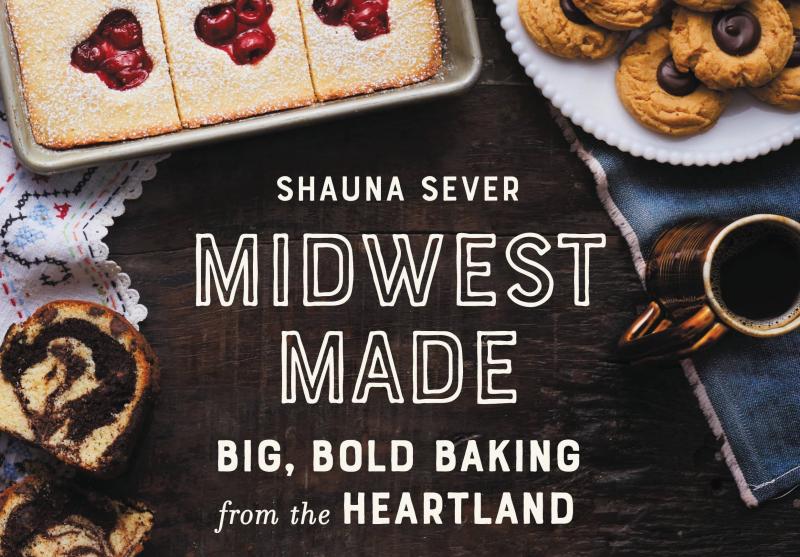
]]>We’re kicking off the club with Shauna Sever’s latest creation, Midwest Made. She’ll be joining us Thursday, November 7th for a demonstration of a few dishes from her new book and the following morning she’ll join us for our inaugural Cookbook Club gathering. We’ll get to watch Shauna demonstrate Danish Kringle—the official state pastry of Wisconsin!—and enjoy sampling it while we chat about the book and share our favorite recipes.
Sign up for Shauna’s November 7th demonstration here and sign up for the Cookbook Club event on the 8th here.
I’m SO in for this! …How exactly do I participate?
Three easy steps.
-
Familiarize yourself with the book. Pick up your own copy, borrow a copy from a friend or the library, find related articles online—you get the idea—and then read it! When our Club event lines up with an author visit you’ll always be able to buy the book (and get it signed) at the event.
-
Head into the kitchen. It’s hard to know what you think of a cookbook without cooking from it, right?
-
Share your thoughts.
a). Online: In the months set for each book (see the schedule below) we encourage you to share what you’re cooking and baking in our BAKE! Facebook group*. The more information you can add into your post the better—book title, author, recipe name, and recipe page. It will help your fellow members know what you’re talking about and help us all find topics we’re interested in (for instance, long after our event with Shauna we’ll be able to easily find previous posts from her book and see what someone thought of a recipe you’re interested in making). You can also share your creations and book feedback on Instagram—make sure to tag your posts with #bakecookbookclub so we see them.
b). In-person discussion: We’ll have an opportunity to gather together in real life for each book we cover, too. This will give us a chance to talk face-to-face about the book, try dishes from the book, and sometimes learn techniques from the book either from the author or from BAKE! staff members.
*The BAKE! Facebook Group is a private Facebook group for BAKE! students. If you’ve taken a BAKE! class, but you’re not yet a member, email lhard@zingermans.com with your name, the email address associated with your Facebook account, and what BAKE! class you’ve taken. If you haven’t taken a class yet, you’ll receive an invite after attending a class or a Cookbook Club event.
Can I bring food to the Cookbook Club events?
Yes! We will always have at least one dish from the current cookbook for everyone to sample, but we know that part of the fun of participating in a cookbook club can be sharing dishes that you’ve made, too. So, you’re welcome (but never required) to bring a dish to share.
Should you choose to bring a dish, please select a dish that will travel well and that is meant to be served at room temperature. If at all possible, bring along a sign to identify your dish with the name and ingredients to help others identify potential allergens. Note that BAKE! (and the Bakehouse) are peanut-free facilities, so dishes made with peanuts or peanut products are not allowed.
This goes without saying… but we’re going to say it again anyway. Should you choose to try dishes that other guests bring in, you’re acknowledging that they were made in a home kitchen, and that we have no way of knowing how they were prepared or if potential allergens were present.
Okay, got it. I’m a planner, what’s ahead?
So glad you asked. We’re planning on having an in-person Cookbook Club event every other month(ish).
October & November
Midwest Made by Shauna Sever
Event: November 8th from 9 – 11 am — reserve your spot here
Sign up to bring a dish here
* This is a unique case, in that you can start sharing in the BAKE! Facebook group now, but Shauna’s book isn’t out until October 22nd. (We know it can be tough to choose a dish to bring when the book isn’t in your hands yet. If you head to the book’s page on Amazon and click “Look Inside” you can see the Table of Contents to help you figure out which one to claim.) We’ll always try to share sources for online recipes (we always want as many people as possible to be able to participate!), but it’s especially important in this case, so here are some to get you started:
– Chocolate Bumpy Cake
– Gooey Butter Cake
December, January, & February
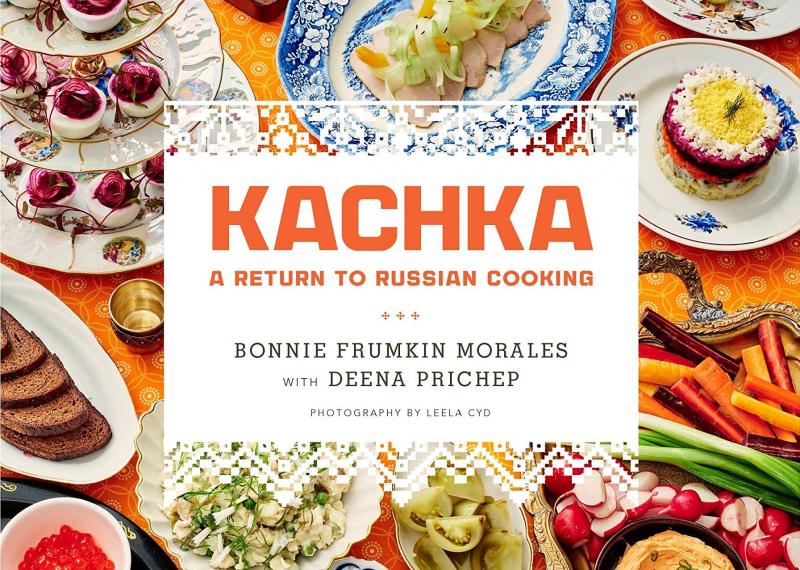
Kachka: A Return to Russian Cooking by Bonnie Frumkin Morales and Deena Prichep
Event: February 5th from 6:30 – 8 pm — reserve your spot here
March & April
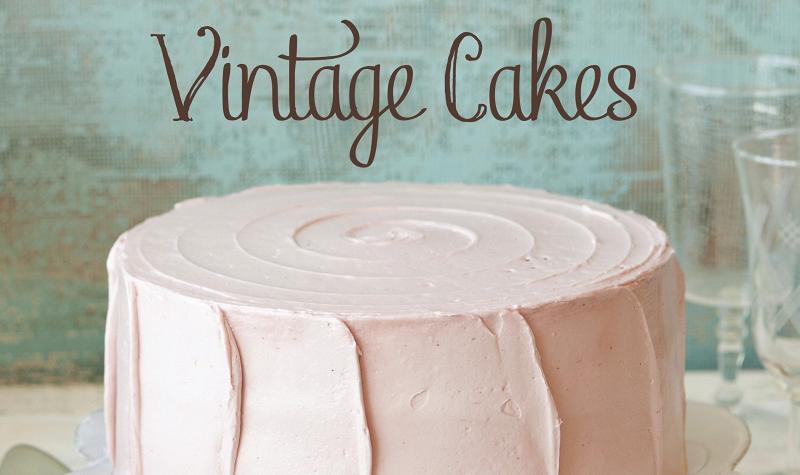
Vintage Cakes: Timeless Recipes for Cupcakes, Flips, Rolls, Layer, Angel, Bundt, Chiffon, and Icebox Cakes for Today’s Sweet Tooth by Julie Richardson
Event: April 22nd from 6:30 – 8:30 pm — reserve your spot here
I still have questions and/or burning suggestions for future books to cover.
Send an email to lhard@zingermans.com, we’re all ears!
The post Introducing Our New BAKE! Cookbook Club appeared first on bake blog.
]]>The post Let Them Eat… Brioche? appeared first on bake blog.
]]>In case you’ve never had the pleasure of a soft, buttery slice of brioche, we’ll gladly fill you in. It’s really a small step away from being a pastry (hence the translation from “brioche” to “cake” in Miss Antoinette’s quote). It has a golden color and rich, soft texture from all the eggs and butter added to the flour, yeast, and salt. It’s great on its own, of course, but it makes rich bread pudding and French toast and takes sandwiches and burgers to another level.

In our Bring on the Brioche BAKE! class, the scent of butter will fill the room when you learn how to make brioche dough, shape it, and bake it to perfection. You’ll get plenty of hands-on practice in class with mixing, kneading, and proofing yeasted doughs—and you’ll be amazed by just how much butter you knead into the dough!
We’ll show you how versatile this dough is by making a variety of treats with brioche. You’ll learn how to make a traditional round shape, called brioche à tête — the brioche dough is baked in a round, fluted pan, and a small portion of the dough is placed on the top to form the head or tête. You’ll make stuffed brioche rolls, with both sweet (chocolate) and savory (sausage) fillings, and a sweet loaf called Craquelin. This national bread of Belgium is rolled up with a layer of fresh orange zest and sugar cubes soaked in Grand Marnier®. The additions form a sweet swirl inside each slice and their dark orange flavors seep into the surrounding dough. We’ll also demonstrate Bee Sting Cake (Bienenstich), a German dessert made with brioche, pastry cream, and a honey almond topping. We’ll also send you home with dough to make another batch of something you made in class—or something else entirely!

If you need more inspiration, you can find brioche at the Bakehouse in a couple of different forms. Frank and Amy, Bakehouse managing partners, tried bostock well over a decade ago and were still thinking about it, so we just had to start making this pastry creation and sharing them with you. Every day, our bakers begin with a thick slice of our buttery brioche bread, brush it with orange-flavored simple syrup, spread it with almond frangipane, sprinkle it with toasted almonds and bake it. It’s a breakfast pastry totally worth getting out of bed for (but it’s good for dessert too!). We also make small brioche rolls (with or without a sprinkling of sea salt on top) that make an irresistible addition to any dinner spread.
Ready to reserve your spot? You’ll leave BAKE! with two loaves, eight rolls, AND dough to bake later.
The post Let Them Eat… Brioche? appeared first on bake blog.
]]>The post Announcing: ALL organic grains in our Roadhouse bread! appeared first on bake blog.
]]>We’re excited about this for a couple reasons: It’s the first grain that we’ve been able to mill ourselves on a larger scale. Freshly milled flour has a number of benefits, among them, that it’s more flavorful and it’s more nutritious, that’s a win-win in our book. An easy comparison is coffee: Would you rather have a cup of coffee made from freshly ground beans or one from beans ground months ago? Fresh, right? We believe the same goes for flour—fresh is better. And freshness doesn’t just apply to the flour, when properly made, breads made with freshly milled flours will stay fresh for longer thanks to the natural oils present in the flour. We’re also excited about milling more flours ourselves due to the benefits of eating whole grains—you can read a little bit about that in our post about our new mill and we’ll be talking more about that in the months ahead, too.
And second, it’s helping us with our goal of going more organic at the Bakehouse. You might remember that in April of last year we shifted to using 100% organic all-purpose wheat flour. We use exponentially more all-purpose flour than any other ingredient, so that switch was a big deal, but one that we felt was an important one to make. Now we’re able to add one of our rye flours to the list of organic ingredients we use including all-purpose wheat flour, cornmeal, 7-grain mix, and more.
The first bread that we’re using our freshly milled rye in is our Roadhouse bread, which was created for Zingerman’s Roadhouse fifteen years ago. At that time, they came to us at the Bakehouse looking for traditional American baked goods to add to their initial lineup, and we were happy to develop a few new signature items for them, including a bread that was common in early American cookbooks, called Thirded bread or Rye and Indian bread, but not so common in bakeries today. Roadhouse bread has stood the test of time both at the Roadhouse and here at the Bakehouse, and it even made it into our cookbook.

Our Roadhouse bread is based on those early American recipes and is made with wheat, corn, rye, and a bit of molasses. It’s got a really great dark crust and soft chewy center that has a slight sweetness from the dark molasses. And, with our shift to organic rye flour, Roadhouse bread is now made with ALL organic flours: the organic rye from Breslin Farms, IL; organic wheat from Bay State Milling, CO; and organic cornmeal from Champlain Valley Milling, NY.
We look forward to incorporating our freshly-milled rye and other grains into more of our breads soon. So keep in touch and follow us for updates!
Lindsay-Jean Hard, Marketer
Bakehouse Grain Commission
The post Announcing: ALL organic grains in our Roadhouse bread! appeared first on bake blog.
]]>The post Introducing Our New Hand-Built, Stone Mill appeared first on bake blog.
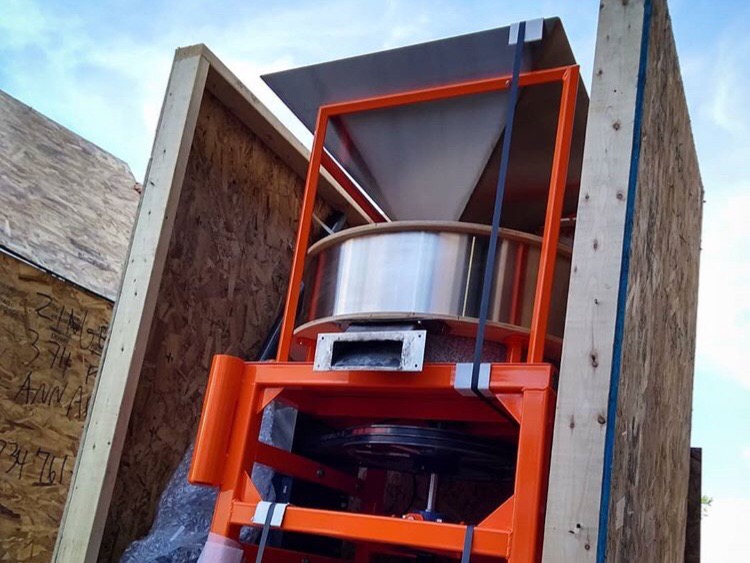
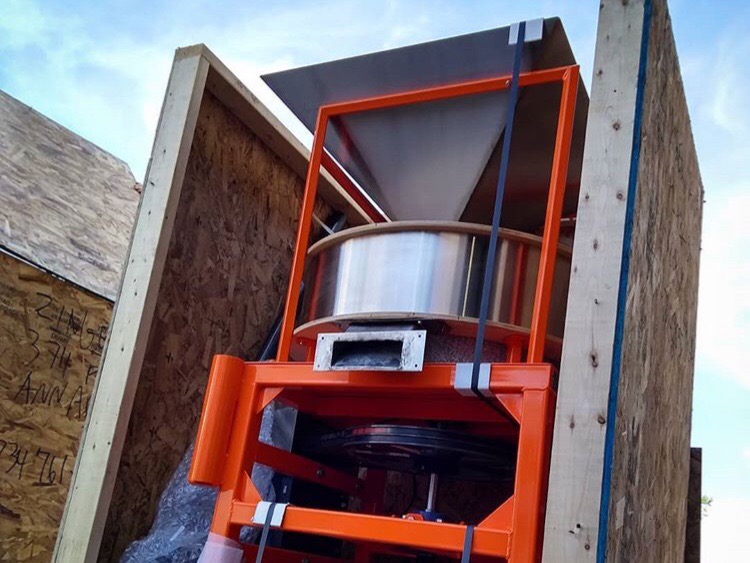
]]>(Heck yes mills can be beautiful! Take a gander at that beaut! At the powder-coated Bakehouse orange frame! …okay, that might not be the true name of the color, but that’s what we’re going with.)
We wanted to use a stone mill both because it’s a traditional form of milling and because the entire grain kernel is ground together: bran, germ, and endosperm. In contrast, modern commercial roller milling produces highly refined flour with only the starch-laden endosperm. By opting for stone milling flour, we still have the option to sift the flour and refine it if desired, but some of the bran and germ will remain, resulting in more nutritious and complex flavored flour. It’s also less wasteful!
We started down this path just over a year and a half ago, when Bakehouse staffer Hazim Tugun (read more about his path to working with us here) would occasionally bring in his breads made with freshly milled flour for us to try. He’s been milling at home for over 3 years now, so he brings a lot of knowledge and experience to our endeavor.

Then in May of last year, Bakehouse co-owners, Amy and Frank attended a bread conference in Charlotte, NC where they met Wolfgang Mock, a passionate advocate for freshly milled flour, and immediately ordered his Mockmill upon returning to Ann Arbor. Once it arrived, we started playing around with milling small quantities of grain, but as it’s meant for home use, we could only mill small quantities. To mill on a larger scale, we’d need to upgrade to a larger mill.
Once we knew we were ready to take that step, we turned to Andrew Heyn. He is the owner of Elmore Mountain Bread and the creator of American Stone Mills, his stone mill building project, both located in Elmore, VT. He starts building mills out of necessity, as explained on the website:
“He wanted to use large portions of fresh-milled, locally-sourced grain in the bakery, and found that commercially available stone mills could benefit from design improvements conceived by thoughtful bakers. He spent months researching, designing and building a new breed of stone mill that uses locally quarried, natural granite, commonly available motors and parts, and the insights gained by working daily with stone mills in bakery settings.”

Back in March of this year, we commissioned Andrew to build one for the Bakehouse. We love that his ultimate goal is, “to build a community of bakers who bring fresh-milled flour to their products, sourced from local grain farmers, to deliver the fullest nutrition and flavor to their customers,” and we’re happy to be a part of making that happen. And, it’s clear that he’s well on his way with furthering that goal—due to popular demand of his mills, we knew we’d have to wait a few months to get ours (it was worth the wait). Around the same time, while we were waiting, we started to educate ourselves about whole grains and formed our Grain Commission.
In anticipation of the imminent arrival of our mill, we met with Andrew this past summer at the 8th Annual Grain Gathering in Burlington, WA and took his Stone Mill Anatomy class, where we learned all about the internal makeup of stone mills, as well as how to maintain them. (Read more about what we learned at this event here.)

It was an exciting day when our mill arrived at the beginning of September. We crowded around the crate to get the first glimpse of it as it was unboxed. If you’re interested in a peek under the hood (or is it, under the stone?) here are a few of the specs on ours:
-
26″ Vermont-quarried Barre Gray granite stones
-
Approximate weight: 1,200 pounds
-
Dimensions: 34″W x 48″D x 66″H (this means it fits through a standard doorway, helpful since it arrived fully assembled!)
-
Stainless steel hopper with 100-pound grain capacity
-
Production rate: 60 to 80 pounds per hour (and that’s for very fine flours; coarser milled products can be fed at a faster rate)
-
We’ve added a sifter, or bolter, to our mill, which is what allows us the option of sifting flour when desired
Andrew visited us later that month to help us get the mill and bolter properly set up, as well as train our staff how to use it. We’ve been doing some milling with a variety of grains and having fun experimenting with them. Expect to see more products with freshly milled flour in the months ahead!
By Lindsay-Jean Hard, Bakehouse Marketer
Photos by Andrew Heyn and Hazim Tugun
PS: The mill will be playing a major role in how we do things here at the Bakehouse, so we think it needs a name. If you have a suggestion, let me know at lhard@zingermans.com—we’ll keep you posted on what we settle on.
The post Introducing Our New Hand-Built, Stone Mill appeared first on bake blog.
]]>